
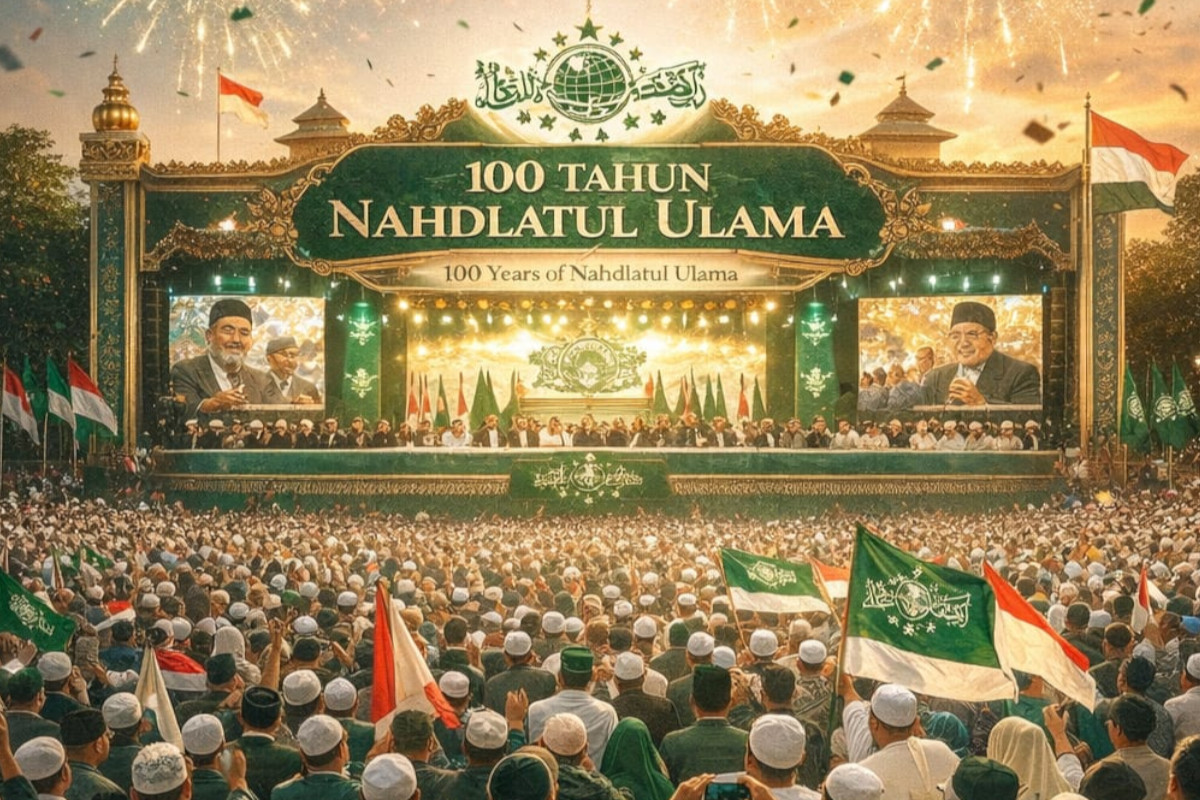
A Century of Nahdlatul Ulama: Tradition Meets the Future
Nahdlatul Ulama celebrates 100 years of devotion, preserving Islamic tradition, empowering communities, and shaping Indonesia’s future while standing firmly at the crossroads of faith, culture, and modern challenges.
MALANG – Nahdlatul Ulama (NU), meaning “Revival of the Scholars,” stands as one of the most influential Islamic organizations in Indonesia and the world. On January 31, 2026, this organization marked its 100th anniversary according to the Gregorian calendar since its official founding in 1926 in Surabaya, East Java.
NU’s formation was driven by a group of Islamic scholars (ulama) who wanted to preserve traditional Sunni Islam (Ahlussunnah wal Jamaah) practices and teachings within the local cultural context of the Indonesian archipelago.
The key event leading to it's birth began with a gathering of prominent ulama, including figures such as K.H. Hasyim Asy’ari and K.H. Wahab Hasbullah, who led efforts to organize a formal body representing Muslim scholars.
Originally known as Komite Hijaz, the committee’s purpose was to send delegates to an international Islamic congress. But the discussions quickly evolved into creating a permanent association of scholars, and thus Jam’iyyah Nahdlatul Ulama was born on 16 Rajab 1344 H (31 January 1926).
Organizational Mission and Community Roots
From its inception, it rooted itself deeply in traditional pesantren (Islamic boarding schools), which were central to religious education across rural Indonesia. Their strong presence in villages and pesantren helped it grow rapidly and influence millions of Indonesians across regions.
NU is portrayed as an organization “born from the village for Indonesia”, highlighting its grassroots origins and its role in community development, cultural preservation, and social empowerment.
NU Through Indonesia’s National Struggles
While the organization began with religious and educational motivations, its role quickly expanded into the national political realm, especially during the struggle for Indonesia’s independence from Dutch colonial rule.
Members played roles in mobilizing support for independence, including in movements such as the Resolusi Jihad soon after the Proclamation of Independence in 1945.
In later decades, the oragnization engaged in national development and political life, including participation in elections and parliamentary activity. Its involvement helped shape the democratic and pluralistic foundations of the Indonesian state.
Timeline of Nahdlatul Ulama (NU)
1926 – Nahdlatul Ulama officially founded in Surabaya by K.H. Hasyim Asy’ari, K.H. Wahab Hasbullah, and other ulama.
1930s – Rapid expansion of pesantren networks, strengthening traditional Islamic education and community influence.
1945 – Nahdlatul Ulama figures contribute to Indonesia’s independence spirit, including the historic Resolusi Jihad.
1952 – Nahdlatul Ulama becomes a political party after separating from Masyumi.
1973 – Nahdlatul Ulama is merged into PPP during the New Order political fusion.
1984 – Under Abdurrahman Wahid (Gus Dur), it returns to khittah 1926, focusing on social, religious, and educational work rather than practical politics.
1999 – Gus Dur, former Nahdlatul Ulama chairman, becomes President of Indonesia, marking NU’s strong moral and intellectual influence in national life.
2000s – Expansion into universities, health services, economic empowerment, and global interfaith dialogue.
2010s – Nahdlatul Ulama strengthens narratives of Islam Nusantara, moderation, and tolerance.
2023 – Nahdlatul Ulama commemorates 1 century in the Hijri calendar with global attention.
2026 – Nahdlatul Ulama reaches 100 years in the Gregorian calendar, becoming one of the largest Muslim organizations in the world.
100 Years: Reflection and Forward Vision
Over the decades, NU has grown into a vast network of institutions and social services. Beyond religious education, it has established universities, community programs, and social welfare initiatives across Indonesia.
As reaching its centenary in 2026 according to the Gregorian calendar, its not just the milestone itself, but also the future direction of the organization. The organization choose Malng as its center of celebration.
Millions of people coming from around the corner just to join the ceremony in Malang, (8/2/2026). The centenary moment was seen not merely as a celebration of age, but as a moment of reflection and strategic transformation for NU entering its second century.
"I've been waiting for this time my whole life, I was wondering whether will I live to this day just to join and gather with all of NU community accros the country," Muhammad, a 65 year old fanatic member of NU who came from Jakarta to Malang just to join the 100th anniversarry of the organization (6/2/2026).
From its humble beginnings as a scholarly committee in Surabaya in 1926, Nahdlatul Ulama has grown into a major social, religious, and cultural force in Indonesia. It has played a role not only in shaping religious life but also in Indonesia’s broader national identity.
As it celebrates 100 years in 2026, Nahdlatul Ulama stands as both a guardian of Islamic scholarship and a vibrant participant in Indonesia’s pluralist society—continuing to adapt its mission for the challenges of the 21st century. (*)
Simak breaking news dan berita pilihan TIMES Indonesia langsung dari WhatsApp-mu! Klik 👉 Channel TIMES Indonesia. Pastikan WhatsApp kamu sudah terpasang.
Berita ini juga tayang di portal nasional
Baca versi lengkapnya di jaringan nasional kami.
